
How Digital Marketing Works: A Complete Step-by-Step Guide for Beginners and Businesses
Introduction to Digital Marketing
How digital marketing works is an important concept for businesses that want to promote their products, services, and brands through online channels such as search engines, websites, social media platforms, email, and paid advertisements. It helps businesses connect with potential customers, increase brand awareness, generate leads, and improve sales.
Unlike traditional marketing methods, digital marketing allows businesses to reach specific audiences, measure campaign performance, and adjust their strategies according to results. Whether you run a small local business or a large company, digital marketing helps you reach the right people at the right time through the most suitable online platforms.
Understanding how digital marketing works makes it easier to choose effective marketing strategies, attract potential customers, and use your marketing budget efficiently to achieve business goals.
Step 1: Understand Your Business Goals
The first step in digital marketing is to identify what you want to achieve. Every business has different objectives, so your marketing strategy should be designed around your specific goals.
For example, a new business may want to increase brand awareness, while an established company may focus on generating qualified leads or increasing online sales.
Common digital marketing goals include increasing website traffic, improving search engine rankings, generating enquiries, attracting local customers, building brand awareness, and increasing sales.
Clear goals help you choose the right marketing channels and measure whether your efforts are producing meaningful results.
Want to grow your leads through digital marketing?
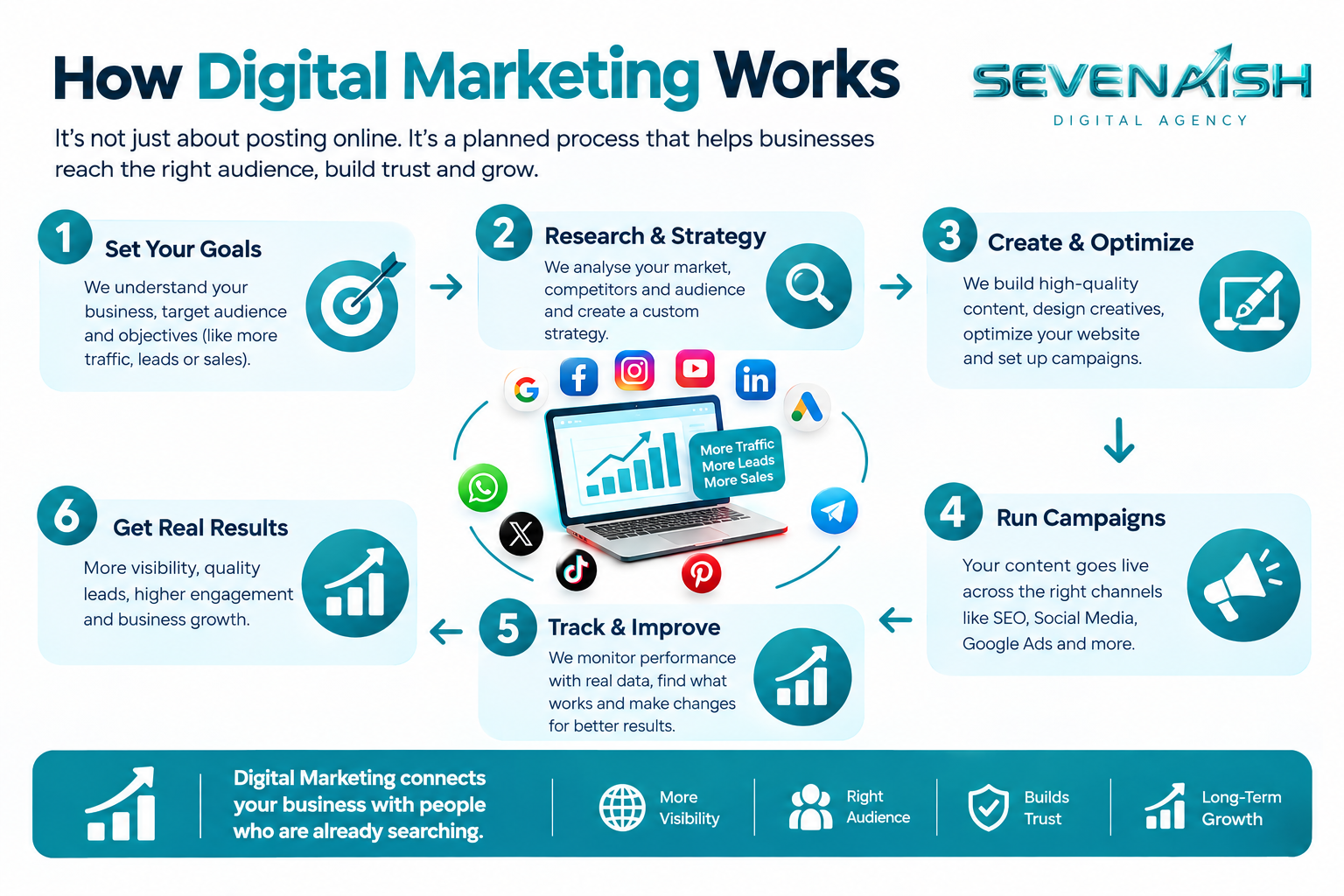
A comprehensive guide explaining how digital marketing attracts audiences, generates leads, converts customers and helps businesses grow.
Step 2: Identify Your Target Audience
After setting your goals, the next step is to understand your target audience. Your target audience includes the people who are most likely to need or purchase your products or services.
You should understand their interests, needs, location, age group, online behaviour, and the problems they want to solve.
For example, if you provide website design services in Amritsar, your potential customers may include local shop owners, restaurants, educational institutions, service providers, and small businesses that want to improve their online presence.
Understanding your audience helps you create relevant content, select suitable advertising platforms, and communicate your services more effectively.
Step 3: Build a Professional Website
A website often serves as the central point of your digital marketing activities. It gives potential customers information about your business, services, pricing, experience, and contact details.
A professional website should be easy to navigate, mobile-friendly, fast-loading, and designed to provide a good user experience.
It should also include clear calls to action, such as Contact Us, Get a Quote, or Request a Consultation, so visitors know what to do next.
Search engine optimisation should also be considered during website development. A well-structured website helps search engines understand your content and makes it easier for potential customers to find relevant information.
Step 4: Improve Search Engine Visibility Through SEO
Search Engine Optimisation, commonly known as SEO, helps improve a website’s visibility in unpaid search engine results.
When people search for products or services on Google, they usually see results related to their search intent. SEO helps businesses create useful content, improve website structure, fix technical issues, and demonstrate relevance to those searches.
SEO generally includes three main areas.
On-page SEO focuses on page titles, headings, keywords, internal links, and useful content.
Technical SEO focuses on website crawling, indexing, site speed, mobile usability, and other technical factors.
Off-page SEO focuses on activities outside your website, such as earning relevant backlinks and building your website’s reputation.
For example, a business offering digital marketing services in Amritsar may create helpful service pages targeting searches related to SEO, website development, and online advertising.
SEO usually requires consistent effort and does not guarantee immediate rankings. However, a well-planned strategy can help attract relevant visitors over time.
Step 5: Create Valuable Content
Content marketing involves creating and sharing useful information to attract and educate your target audience.
Content can include blog articles, service pages, videos, infographics, social media posts, case studies, and frequently asked questions.
For example, a digital marketing agency could publish articles explaining how SEO works, how much website development costs, or how businesses can generate leads through Google Ads.
Helpful content answers customer questions, builds trust, and supports SEO by giving search engines relevant information to understand.
The objective is not simply to publish more content. It is to provide accurate, useful, and relevant information that helps people make informed decisions.
Step 6: Promote Your Business on Social Media
Social media marketing helps businesses connect with audiences through platforms such as Facebook, Instagram, LinkedIn, and YouTube.
Businesses can use these platforms to share updates, demonstrate their expertise, showcase completed projects, answer customer questions, and build relationships with potential customers.
For example, a clothing boutique can share new designs, styling tips, and customer experiences. A digital marketing agency can publish website projects, marketing tips, and campaign insights.
Each platform serves different purposes. Instagram may be useful for visual content, while LinkedIn can be valuable for professional networking and B2B marketing.
Consistent posting, relevant content, and genuine audience interaction can help businesses strengthen their online presence.
Step 7: Run Paid Advertising Campaigns
Paid advertising allows businesses to promote their products or services to selected audiences by paying for advertising placements.
Google Ads can display advertisements when people search for specific products or services. Social media advertising can help businesses reach audiences based on factors such as location, interests, and platform behaviour.
For example, a website design company in Amritsar could run Google Ads targeting people actively searching for website development services in the area.
Paid campaigns can generate visibility and enquiries relatively quickly, but results depend on targeting, budget, competition, landing page quality, and the offer being promoted.
Businesses should monitor their advertising costs, clicks, conversions, and lead quality to understand whether their campaigns are delivering value.
Step 8: Use Email Marketing to Build Relationships
Email marketing helps businesses communicate directly with people who have subscribed or otherwise agreed to receive their communications.
It can be used to share company updates, helpful resources, service information, special offers, and follow-up messages.
For example, a business can send useful tips to existing customers, provide updates about a new service, or follow up with a prospective customer who has requested information.
Email marketing is particularly useful for nurturing leads and maintaining customer relationships over time.
Messages should be relevant, personalised where appropriate, and sent in accordance with applicable consent and privacy requirements.
Step 9: Convert Website Visitors into Customers
Getting visitors to your website is only one part of digital marketing. The next step is encouraging those visitors to take meaningful action.
This process is often called conversion optimisation.
A conversion could be a phone call, a contact form submission, a quotation request, a newsletter subscription, or a completed purchase.
Businesses can improve conversions by simplifying forms, making contact information easy to find, improving page speed, providing clear service details, and displaying genuine testimonials or relevant case studies.
For example, if a website receives many visitors but very few enquiries, the business may need to improve its service page, strengthen its call to action, or make the enquiry process easier.
Step 10: Track Performance and Analyse Results
Digital marketing works best when businesses regularly measure performance and use the findings to improve their strategies.
Tools such as Google Analytics and Google Search Console can provide useful information about website traffic, search visibility, user behaviour, and conversions when configured appropriately.
Important performance indicators include website visits, organic search clicks, keyword visibility, advertising cost, conversion rate, qualified leads, and return on advertising spend.
For example, if a campaign generates many clicks but few enquiries, you may need to review the audience, keywords, advertisement, or landing page.
Regular analysis helps businesses identify what is working, reduce wasted spending, and make better marketing decisions.
Step 11: Improve and Optimise Your Strategy
Digital marketing is an ongoing process rather than a one-time activity. Customer behaviour, competitors, search engine systems, and market conditions can change over time.
Businesses should regularly update website content, review SEO performance, test advertising messages, improve landing pages, and evaluate social media engagement.
For example, if one service page generates more qualified leads than another, you can study what makes it effective and apply those insights to other pages.
Continuous improvement helps businesses adapt to changing customer needs and make better use of their marketing resources.
Different Types of Digital Marketing and How They Work
Search Engine Optimisation (SEO): Improves visibility in unpaid search results and helps attract relevant website visitors.
Search Engine Marketing (SEM): Often used to describe search engine marketing broadly, including paid search advertising; terminology varies by context.
Social Media Marketing: Uses social platforms to build awareness, engage audiences, and promote products or services.
Content Marketing: Provides useful information through articles, videos, guides, and other content formats.
Pay-Per-Click Advertising (PPC): Allows businesses to pay for advertising clicks under applicable campaign pricing models.
Email Marketing: Communicates with subscribers and customers to build relationships and encourage repeat engagement.
Website Design and Development: Creates the online platform where customers can learn about a business, evaluate its services, and take action.
Conversion Rate Optimisation (CRO): Improves website experiences to increase the percentage of visitors who complete desired actions.
How Digital Marketing Works Together
The best results often come when different digital marketing channels support one another rather than operate independently.
For example, a business publishes an SEO-focused blog to attract visitors from Google. It shares the article on social media to reach a wider audience. It may use paid advertising to promote a relevant service and then track how many visitors submit enquiries through its website.
The business can analyse these results to understand which channels attract the most relevant customers and allocate its budget accordingly.
This connected approach helps create a consistent customer journey, from discovering a business to evaluating its services and eventually becoming a customer.
Conclusion
Digital marketing works by connecting businesses with their target audiences through online channels, providing useful information, promoting relevant services, and measuring the results of marketing activities.
The process begins with clear business goals and audience research, followed by website development, SEO, content marketing, social media promotion, paid advertising, and performance analysis. Each step contributes to attracting potential customers, building trust, and encouraging conversions.
For beginners, the best approach is to start with clear goals, build a strong online presence, and focus on the marketing channels most relevant to their audience. Businesses can then use performance data to refine their strategy and grow their online presence over time.